pages

Showing posts with label eggs. Show all posts

Friday, December 17, 2010

Pumpin' outta the chicken gun...

From the country...

The ladies are not slowing down anytime soon. It will be definitely an egg Christmas around here! (lots of baking, egg gift giving and egg breakfasts for guests).

30 of the 45 turkeys residing in the barn will make their way to the abattoir next week and end up as the main feature in many a Christmas turkey dins. That should make chores a little easier for this rotund farmer, waddling my way to the barn with full buckets. The 15 left behind will live another season hopefully proving themselves useful in the breeding pens and hopefully meaning more turkeys for sale next winter. This years brood didn't last long before customers snatched them up. If all goes well this could turn out to be a profitable venture (a girl can dream right?). It feels really satisfying to see something through to the end and know that you gave your livestock the best you can offer (quality feed, raising them on pasture, letting them live the most natural life possible) and then knowing that these beauties will be someones special Christmas feast.
The food we eat should be this special!

Lets take time to find a farmer who cares and direct our money elsewhere then the Butterball from the grocery store and chose our meat that actually had a life. A life that was respected from the pip of the egg to the humane slaughter. It feels so self satisfying to be a farmer and be able to cherish life and respect the meat that goes into my family's bellies. I will sure savour and cherish my heritage turkey stuffed with a our own sausage dressing this Christmas and might even shed a tear or two because, the gift of raising your own meat and growing your own vegetables to share with your loved ones is an amazing gift.

Egg nog anyone?

Tuesday, June 15, 2010

CSA Share Numero Uno

From the City...

I picked up my first CSA (Community Shared Agriculture) box on Friday and this was the core list that every large share was given:

A huge bunch of spinach
Large bunch of spring onions
Bunch of rhubarb
Quart of Fingerling Potatoes
Head of Romaine
Choice of herbs (I chose parsley)

In addition that that core list, I had $15 extra dollars that I could spend on the table. The table being loaded up with fresh bread, jam, jelly, meats, honey, maple syrup and other goodies.
We were in desperate need of eggs and maple syrup so that's how we spent our money.

What I've really enjoyed about this first share is that I've had to work with what I'm given and my recipes have had to reflect only what is in the box that given week. Simon and I are making a real effort to only eat what the box provides, minus some avocados and oranges of course.

So here's what I've cooked up so far.


Scrambled eggs with green onions, spinach and ontario goat cheese.

Roasted fingerling potatoes (smothered in Ketchup a la Simon), grass fed organic steak from Kawartha Ecological Growers, spinach and romaine salad with balsamic vinaigrette.


Homemade Falafels with Yogurt (with minced garlic)

Recipe:
4 cups cooked chickpeas ( 2 15 oz cans)
4 medium cloves garlic
2 tsp cumin
2 tsp salt
2 green onions (4-5 if they are smaller, like I said, mine were quite large)
1/4 cup parsley
1/3 cup water
1 tbsp lemon juice
1/3 cup flour
oil for frying (I used coconut and it turned out pretty well)

1. Rinse chickpeas and drain well.

2. Combine all ingredients except flour, in a food processor and process until you have a uniform batter

3. Add flour and stir until thoroughly combined.

4. Heat a heavy skillet and add about 3 tbsp of oil. When it's hot enough to sizzle, drop tablespoons of of batter onto pan, flattening each slightly. Saute for about 10 minutes on each side, until golden and crisp.

5. Serve with pita and yogurt.

....I wonder what goodies I'm gonna get this week...

Saturday, February 27, 2010

Sunday Deliciousness

From the City:
Simon loves pancakes, like loves pancakes. Whenever we go out for breakfast, he always orders a standard breakfast (eggs, bacon, toast) with a side of pancakes. For him, this is the perfect combination of sweet, salt and fat.

So in order for our relationship to be long lasting (7 years this September) certain things had to be mastered:
  • I had to learn the art of tickies. This is a family term for tickling the head, arms or back and occurs mainly in the evenings
  • Learn the art of multi- tasking by watching a movie while also working on a laptop and carrying on conversation
  • Make a mean stack of blueberry pancakes

Here are some tips to making perfect pancakes:

1. Before you ladle on the pancake batter, wipe access butter off the griddle with a folded paper towel. This will make sure you have perfectly browned pancakes.

2. Use all purpose flour in the batter. Cake flour can turn soggy when you top it with syrup. Experiment with different flours like buckwheat or whole wheat just substitute half of the all purpose for any of these.

3. Never whisk batter until it's smooth. Lumps are a good thing and will result in fluffier pancakes.

4. Flip pancakes just as the surface bubbles begin to burst. Flipping them after makes for flatter pancakes.

5. When adding blueberries, bananas or chocolate chips (only some of the many additions you can make) sprinkle them over the batter right after they have been poured on the griddle. This will make sure they are distributed evenly and it also makes them look prettier on the plate, which can sometimes be just as important as how they taste.

6. Warm pure maple syrup before serving. It makes for a certain extra little bit of specialness to the morning (or evening, whatever, no judgement here)

Here's a good (basic) recipe that should keep 'em coming for more:
  • 1 cup all-purpose flour (spooned and leveled)
  • 2 tablespoons sugar
  • 2 teaspoons baking powder
  • 1/2 teaspoon salt
  • 1 cup milk
  • 2 tablespoons unsalted butter, melted, or vegetable oil
  • 1 large egg
  • 1 tablespoon vegetable oil
  • Assorted toppings, such as butter, maple syrup, confectioners' sugar, honey, jams, preserves, sweetened whipped cream, or chocolate syrup
  • Directions
  1. Preheat oven to 200 degrees; have a baking sheet or heatproof platter ready to keep cooked pancakes warm in the oven. In a small bowl, whisk together flour, sugar, baking powder, and salt; set aside.
  2. In a medium bowl, whisk together milk, butter (or oil), and egg. Add dry ingredients to milk mixture; whisk until just moistened (do not overmix; a few small lumps are fine).
  3. Heat a large skillet (nonstick or cast-iron) or griddle over medium. Fold a sheet of paper towel in half, and moisten with oil; carefully rub skillet with oiled paper towel.
  4. For each pancake, spoon 2 to 3 tablespoons of batter onto skillet, using the back of the spoon to spread batter into a round (you should be able to fit 2 to 3 in a large skillet).
  5. Cook until surface of pancakes have some bubbles and a few have burst, 1 to 2 minutes. Flip carefully with a thin spatula, and cook until browned on the underside, 1 to 2 minutes more. Transfer to a baking sheet or platter; cover loosely with aluminum foil, and keep warm in oven. Continue with more oil and remaining batter. (You'll have 12 to 15 pancakes.) Serve warm, with desired toppings.
Side note:
These are some pics from the summer when Laura and I took the kids and went blueberry picking. It's a great, really economical way to stock your freezer with juicy berries for the long winter months.

Have a nice Sunday everyone!


Monday, February 15, 2010

Feels a little like Sunday...

From the City...

For me, there is nothing better than the weekend and even more, there is nothing better than Sundays. Last weekend L was in Toronto staying with Simon, Ruby and I. In true Toronto fashion, we went out for dinner at our favorite spot in China town, took in a $5 Sunday morning yoga class and after had an unbelievably delicious brunch.

So here's the breakdown of what we had:

L brought these unbelievably cute, blue poulet eggs and a hunk of really good ham. I made a loaf of whole wheat bread, a la sullivan street bakery recipe (recipe to follow) , a hunk of really good ontario cheese from the local cheese store and these adorable sprouts that L grows herself and sells at the Green Barns Saturday morning market at St.Clair and Christie.

Here's the very famous Sullivan Street Bakery Bread Recipe that is so good, so easy but requires just a little time and planning.

Formula:

3 cups (400g) flour
1½ cups (300g or 12 oz) water
¼ teaspoon (1g) yeast
1¼ teaspoons (8g) salt
olive oil (for coating)
extra flour
Equipment:

Two medium mixing bowls
6-8 qt. pot (Pyrex glass, Le Creuset cast iron, or ceramic)
Wooden spoon or spatula (optional)
Plastic wrap
Cotton dish towels (not terrycloth), 2 or 3

Process:

Mix all of the dry ingredients in a medium bowl. Add water and incorporate by hand or with a wooden spoon or spatuala for 30 sec. to 1 min. Lightly coat the inside of second medium bowl with olive oil and place the dough in the bowl. Cover the bowl with plastic wrap and let the dough rest 12 hrs. at room temperature (approx. 65-72'F).

Remove the dough from the bowl and fold once or twice. Let the dough rest 15 min. in the bowl or on the work surface. Next, shape the dough into ball. Generously coat a cotton towel with flour, wheat bran, or commeal; place the dough seam side down on the towel and dust with flour. Cover the dough with a cotton towel and let rise 1-2 hrs. at room temperature, until more than doubled in size.

Preheat oven to 450-500'F. Place the pot in the oven at leat ½ hr. Prior to baking to preheat. Once the dough has more than doubled in volume, remove the pot from the oven and place the dough in the pot steam side up. Cover with the lid and bake 30 min. Then, remove the lid and back 15-30min. uncovered.
Have a good weekend everyone!

Turkey Tom

From the country...

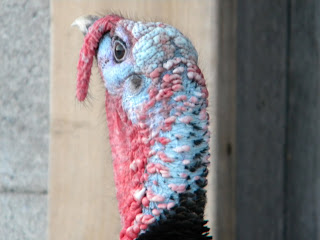
As the days lengthen and there are more daylight hours, my man Turkey Tom is on the prowl...

He was hatched from the incubator last June, a tiny little helpless poult and now has blossomed into a full-blown male turkey. A Tom. He doesn’t like visitors or me taking eggs from under a hen, he pops down from the roost in the evening to chase me outta the coop, and he loathes kids. Other than that he is a great guy, just doing what a Tom does. We used to get along and sometimes still do, but there is the odd time when he sees me as the enemy (unless I have the feed bucket…). I know I shouldn’t let him taunt me but the way he looks at me with those menacing eyes as he sways his multicoloured head back and forth making a shrill call, it’s enough to make me want to run. I don’t though; I stand my ground, putting my barn boot out as he charges. I arm myself. It’s a little thing called the barn broom and with it I have all the power. No rooster or tom dare touch me when I have the barn broom in my hand. A swift sweep and they go flying.

Now let us talk about Tom. He is referred to as a Tom or a Gobbler and is probably one of the more weirdly interesting animals Momma Nature has engineered. He is beautiful in one sense with his interesting plumage of iridescent black feathers with white and brown on the underside. He gracefully dances around the coop from one end to the other; all puffed up like a parade float, making interesting calls and hums. But in another sense he is oddly scary looking with his caruncle (the bumpy growths on his head and neck), his wattle (reddish growth covering his throat and neck), and his snood (long flap of skin that grows from the base of his beak, hanging down over his beak) which makes me question Momma Nature a bit. Was she joking when she made Tom? What are the benefits of having a snood? To me, it just looks like it is in the way.

My Tom is a Narragansett turkey. Historically he was the turkey of New England, the Narragansett Bay area. He is a heritage breed turkey and was the largest of the flock last year. I kept him and some hens (a Bourbon Red girl and Black Spanish girl) for breeding. I will be trying my hand (for the first time…) at breeding this spring. The rest all found a home on someone’s plate.

So in a turkey shell, I am planning on raising heritage turkeys this year from the egg to the table. I am busy contacting other growers and hatcheries to gathering eggs for home hatching. I want to raise many birds and develop some breeding pairs for the following year. Easier said than done. Heritage turkeys are hard to find. For now Turkey Tom will be my little experiment. Hopefully he will court the ladies well and produce some nice fertile eggs.

Just watching the mood change in the barn lets me know that spring is on its way. There is no need to listen to a stinking groundhog when you have a coop full of poultry!


Is All Chicken the Same?


From the country....
On January 24 2010, I attended the Slow Food Chicken Tasting at Victor Restaurant in T.O. The highlight of the night was getting to taste chickens that I had raised and comparing this breed with 4 other heritage breeds. I honestly didn’t know what to expect. The dominant question was: Does all chicken taste the same? Chicken has received such a bad rap for quite some time now and the fact that most people can only get the factory raised, genetically mutated, tasteless, watered down, anaemic chicken wrapped in cellophane, gleaming under the fluorescents at the grocery store, the idea of tasting different varieties of poultry was refreshing. But I didn’t know whether other people would think this way. Chicken just doesn’t have the same appeal as beef, pork, even lamb. Chicken is just chicken is just chicken. Chicken is just that blank protein that needs to be adulterated to make it taste like something; you might as well eat tofu (no offence soy industry!). Who knew there are different chicken varieties? Are there taste benefits to eating heritage chicken?

Of course I knew these answers, I have been raising chickens first hand for some time now. But I am the minority and most people do not raise meat for their table. We eat a lot of chicken here on the farm, and I often feel guilty that we have these beautiful chicken dinners were one day the chicken is on pasture and the next on the tip of our fork. Chicken can be flavourful, sweet, delicate meat and it is a shame that not everyone has truly tasted it. I wondered whether anyone really cared about chicken and as I looked around the restaurant last night, I was so pleasantly surprised that people do in fact still have faith in chicken! They really do!! I clucked all night like a hen in a dust bath!

The tasting was put on by Slow Food Toronto and led by Carrie Oliver from the Oliver Ranch Company with commentary by my partner, Mark Trealout from Kawartha Ecological Growers on the various breeds of chicken and how they were raised. He stepped lightly around the topic of chicken policy and the bleak view of poultry in Ontario and instead let the night be all about the celebration of chicken. We tasted 4 breeds of chicken Americauna (from our farm), Barred Plymouth Rock, Jersey Giant, and Buff Orpington. All these breeds were raised here in the Kawartha Lakes and all by our grower group. We all practice sustainable and ecological growing and is the same with animal husbandry. These chickens were raised with complete access to pasture and fed a local non-GMO feed supplemented with produce seconds, sprouted grains etc. These four chicken breeds fall under the category of heritage chickens.

A brief description of a heritage chicken is that a breed must be recognized by the American Poultry Association, must be able to mate naturally, must have the genetic ability to live a long life thriving in a pasture based outdoor setting, hens should be productive for 5-7 years and roosters 3-5 years and must have a moderate to slow growth rate reaching market weight no less than 16 weeks of age. This gives the bird more time to develop naturally and develop strong skeletal structure and healthy organs before building muscle mass. When a chicken is allowed to grow slowly the result is simple: healthy and super tasty chicken. Let’s compare this description with the standard chicken breed most readily available. The standard chicken (the White Rock) is ready for market in a hasty 8 weeks and cannot mate naturally. The White Rock chicken is rarely raised outdoors and is so genetic weak that is very susceptible to disease, heart issues, leg issues (the list goes on.), it feels like we are eating chicken that belongs in a fictitious poultry hospital, not our bellies…. There are some reputable growers raising these White Rock chickens in a more pastoral setting with quality feed and real sunshine but the fact is this chicken just doesn’t know how act like a chicken. I have raised these chickens in the past and I am sworn off these white mutations, for the fact that they just do readily take to pasture. You can lead a chicken to pasture but can you make it graze?

Now that I have bashed these chickens, let me tell you what they are excellent for. Poussin. Poussin is a French word for small chicken (ideally just under two pounds dressed). The White Rock lends itself beautifully to this, a young, tender bird that melts in your mouth. Consider this the ethical veal of the poultry world raised only 4-5 weeks of age on non-GMO grain and pasture. We enjoy the odd poussin available from our grower group (Kawartha Ecological Growers).
Back to the tasting, the birds were prepared 4 different ways by the super talented David Chrystian from Victor Restaurant, Donna Dooher from Mildred’s Temple Kitchen and Marc Dufour from The Wine Bar. The first preparations a simple roast chicken seasoned with salt, followed by pan seared, braised and a shot of broth to finish (let’s not forget the appetizers chicken liver pate on crustinis and chicken wings!) Each plate had 2 pieces of meat (white and dark), with all breeds represented on each plate. I was astounded by the textural and taste difference between the breeds.

The Americauna rooster is a smaller bird with wild colour variation in their feathers depending on variety. These particular birds were red and black with an iridescent gleam, a smaller comb and a black beard. The Americauna was probably the smallest of all the birds and the most difficult to prepare (according to the chefs..). They have a smaller frame with little breast meat. In the roast category it had a nice bite but not an ideal bird for roasting. Where the Americauna stood out was in the pan seared and broth categories. I tasted hints of onion and an over all sweet flavour. The Barred Plymouth Rock (a large majestic bird with a large red comb and a plume of black and white) and Jersey Giant (a large black rooster from New Jersey circa 1920) were my least favourites. Their tastes and textures were very bold. The meat on these birds was earthy with tastes of mineral and blood. The texture of the meat was firm and dense with a little more chew then the other breeds. This is not to say that I didn’t like these breeds on the flavour front, I would just cook them at home differently, more slowly cooked. That is were these breeds stood out, when they were treated more slowly and braised. Lastly, the Buff Orpington a large framed bird with feathers of a soft golden colour, which mirrors their docile disposition. This was my favourite for a roast bird. The texture of the meat was like silky butter and melted in your mouth. It basted itself nicely with its own fat (which this bird had lots of!) and was the picture of a Sunday evening roast chicken. The taste was sweet with hints of corn and buttery deliciousness! When pan seared the flavour was reminiscent of fried chicken and the bones lent themselves nicely to the broth portion of the tasting.

All in all, the evening was an eye opener, even for us farmers! The taste and texture variant between the breeds was astounding. In the end each breed had it’s own flavour and it’s own strengths. Everyone at the tasting had his or her own favourite breed and no breed outshone any other. The trick for the home cook is to know how to prepare these birds. My suggestion for this is to meet a farmer (at the market or otherwise) and ask them how to prepare their particular breed and when in doubt braising is a nice way to prepare your bird. I strongly recommend trying these heritage breeds (although hard to find) and having a taste test of your own. We need to re educate ourselves in what real chicken tastes like. Poultry that has had time to ripen, that has been bathed in the sun and gorged on pasture. Real chicken is out there it just needs support. By creating a demand for these breeds, it allows farmers to catch a glimpse of the past when there was more than one breed available and when chicken tasted a hell of a lot more like chicken.

Monday, February 8, 2010

Seedy Monday


From the Country….

Spent the last two days organizing seeds form last year and ordering a fresh new crop of seeds for this season. It’s always exciting to peruse seed catalogues with their glossy pictures and snappy write ups, filling you with the idea that you can grow anything! The truth is not every fruit and vegetable is gonna grow in your soil. (oh how I long for a crop of artichokes!) Our short growing season doesn’t allow a lot of leeway for certain vegetables that take there time to produce a crop. It’s often a crapshoot for things like tomatoes and peppers (especially the hot varieties). Its not to say that you can’t, It’s just you have a lot of variables often not in your favour (the horrible all consuming late frost in June and that of the early variety that can veer it’s frosty head your way early into September). It is all about the season and whether Momma Nature is gonna be good to you this year. My Granny says to never put a sensitive seedling out until after the full moon in June. I live by these words. Although I have resigned myself to the fact that a meaty heirloom tomato (you know the one, bigger than your fist with that sweet but tart juice that runs down your chin with every bite...) just isn’t gonna happen here on this farm there are some nice alternatives. Although I long for a crop of Cherokee Purple tomatoes, wild cherry varieties is what I have to settle on. They are super sweet and about as tiny as a marble. They have a monstrous plant and are very prolific. You can harvest then in clusters (just snip the whole branch off) or individually pick them (with the patience of a saint…) A must have for the garden. I order mine from Salt Spring Seeds. This year, for me, it’s all about greens (both Asian and various lettuces) zucchini, some squash, Thai eggplant, herbs and heritage poultry. The last thing you can’t order from a catalogue but that’s another story so stay tuned for that one….
The Roosters in the barn are in their prime crowing away, it’s almost deafening when you go in there. I have way too many roosters and not enough hens, the product of hatching your own. To my amazement there isn’t any cock fighting, everyone seems to be getting along just swell. Maybe too well though, then hens are getting drilled pretty heavily. Poor girls, all the want to do is dust bathe, eat and lay the odd egg (it is winter for goodness sake!) and now they have to contend with the likes of probably over dozen roosters. I am often flabbergasted of how blatantly obvious these guys are, doing it right in front of me. They often meet with the end of my rubber boot! I have to stick up for the ladies! The girls spend their days in hiding with their backs to the wall of the coop their only safe haven is the nesting boxes where they lay their eggs and then I come along and steal their hard earned work. Anyway, I am out to the barn to collect eggs and then finish my seed ordering. I will leave you with this quote I found from my discounted date book that I recently purchased.

I’m not afraid of storms, for I am learning how to sail my ship.
-- Louisa May Alcott
Pin It "> Related Posts with Thumbnails Pin It